
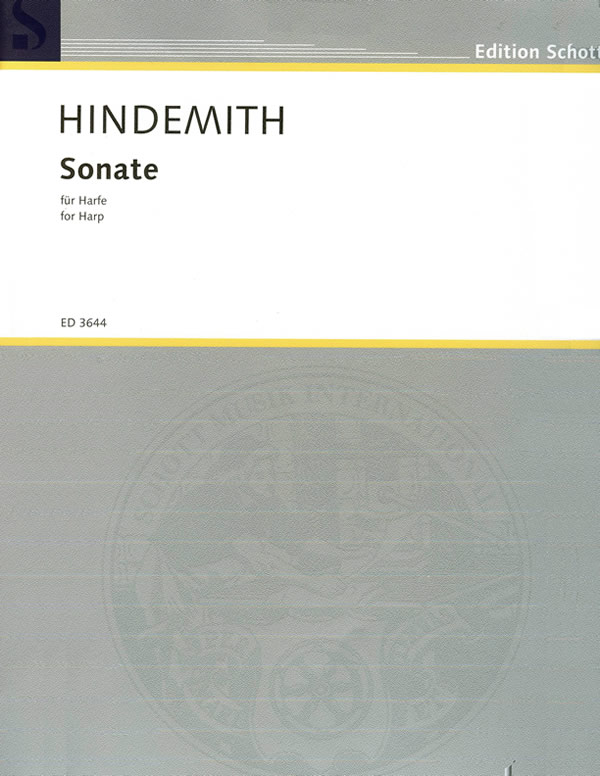

Paul Hindemith (1895-1963) was a German composer, theorist, viola player and conductor. In Germany, Hindemith was considered the successor to Richard Strauss. However his style is quite different, embracing neo-classicism, atonality and the baroque structures of J.S. Bach. Harpists are indeed lucky to have such a composition in their repertoire.
Written for Clelia Gatti Aldrovandi in 1939, the Harp Sonata is romantic in nature though classical in structure. The third movement, “Lied” is prefaced by one of Hòlty’s poems.
Harpist Marcel Grandjany’s (1891-1975) extramusical interpretation of this piece has been incorporated into the performance history of this work. Grandjany stated that the first movement reminded him of “a cathedral, majestic and beautiful. In the end, the shadows grow longer and longer, the sun descending in the afternoon.” Grandjany described children playing in a churchyard as the image evoked by the second movement. The third movement of this work is prefaced by a poem by Ludwig Heinrich Christoph Hölty which describes a poet’s harp hung behind the alter of the church at the poet’s funeral. The sounds of the harp echo in the church with a melody that scans to the lines of this poem:
Lied
Dear friends, when I have departed,
Place the little harp behind the altar,
Where on the wall, the wreaths of
Many young maidens gleam.
Then, the sexton shows the little harp
To the friendly traveller, and the
Red ribbon, twined around the harp,
Rustles and flutters below the golden strings
Often at sunset – he says with awe,
The strings hum quietly like bees,
And the children, hearing the sounds
Run in from the churchyard and
See the wreaths quivering.


Reviews
There are no reviews yet.